
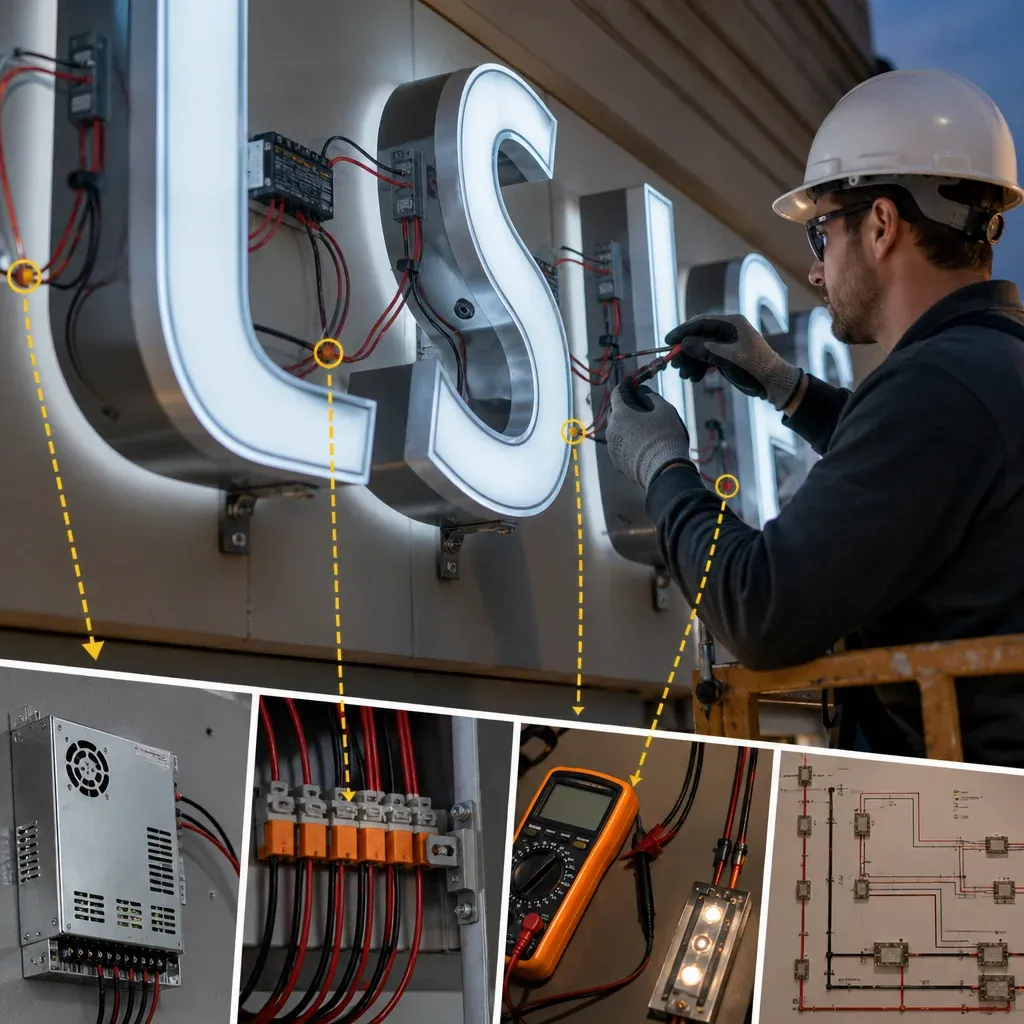
Top 8 Channel Letter Sign Power Injection Strategies for Southlake Businesses
1. Understanding Power Injection Fundamentals for Channel Letters
Channel letter signs command attention on Southlake storefronts, but they demand precision in their electrical setup. Without proper power injection strategy, even the most stunning illuminated signage underperforms, flickers, or fails prematurely. We've designed hundreds of channel letter signs across Texas, and what separates reliable installations from problematic ones comes down to how power flows through the system.
This guide walks you through eight critical power injection strategies that ensure your commercial signage operates flawlessly, maintains consistent brightness, and delivers the visual impact your brand deserves.
Power injection in channel letters means strategically feeding electrical current into the sign at multiple points rather than relying on a single entry. This approach prevents voltage loss, maintains uniform illumination across all letters, and reduces stress on individual electrical pathways.
Think of it this way: if you feed all power through one point at a sign's end, the current travels the entire length of your wiring. By the time it reaches distant letters, voltage has diminished, creating dim spots or color inconsistencies. Multi-point injection distributes the load evenly, so every letter receives adequate power simultaneously.
Standard practice dictates injection at intervals no greater than 50 feet, though tighter spacing improves results significantly. We typically recommend assessment of your specific sign length and letter configuration before finalizing injection points.
What to do next: Measure your sign's total length and count individual letter sections. This data informs how many injection points you'll need for optimal performance.
2. Selecting the Right Power Supply Capacity for Your Signs
Undersizing your power supply ranks among the costliest mistakes in commercial sign installation. Many contractors select transformers based on minimum specifications rather than accounting for real-world conditions, environmental factors, and future brightness adjustments.
Your power supply must handle the sum of all LED wattage, plus a safety margin of 20-30 percent. If your signage draws 400 watts total, select a 500-550 watt transformer, not a 400-watt unit operating at maximum capacity continuously.
Consider these capacity factors:
Total LED wattage across all letter sections and any accent lighting
Ambient temperature conditions (outdoor Texas heat affects transformer efficiency)
Potential future upgrades or brightness increases you might request
Control systems that may add minor electrical loads
Oversizing the transformer by 20-30 percent extends equipment lifespan, maintains cooler operating temperatures, and provides headroom for adjustments without replacement.
What to do next: Compile the wattage specification for every LED element in your sign design. Add 25 percent to that number and select your transformer accordingly.
3. Proper Wire Gauge Selection to Minimize Voltage Drop
Wire gauge directly impacts how much voltage your system loses across distances. Most Southlake business owners don't realize that using undersized wiring is functionally identical to undersizing the transformer: it creates dimmer letters and potential failures.
Voltage drop exceeding 3 percent of your system voltage is unacceptable for decorative lighting. For a 277-volt system, that's roughly an 8-volt maximum loss. Calculate voltage drop using wire length, current flow, and conductor resistance.
Here's the reality: running 15 amps through 50 feet of 14-gauge wire creates approximately 5 percent voltage drop. Switch to 10-gauge wire over the same distance and drop falls to 1.5 percent. The cost difference is minimal compared to the performance gain.
Our approach prioritizes upsizing wire gauge conservatively, especially for distances exceeding 25 feet or for signs with high total amperage. This engineering principle prevents future issues and simplifies troubleshooting.
What to do next: Calculate your sign's total amperage at your system voltage. Request a voltage drop analysis from your electrician before any installation begins.
4. Strategic Transformer Placement Along Your Signage
Where you position your transformer influences power distribution efficiency and installation complexity. Most contractors place transformers at the nearest convenient location, which isn't always the optimal choice.
Ideally, your transformer should sit as centrally as possible relative to your letter sections. A sign spanning 80 feet benefits from transformer placement near the 40-foot mark, allowing power to travel roughly equal distances in both directions. This symmetry reduces voltage drop and simplifies wire routing.
Practical constraints often require compromise. Building codes, roof structure, existing conduit, and utility access shape final placement decisions. The key is acknowledging these factors early and selecting the best feasible location rather than defaulting to convenience.
Environmental protection matters equally. Your transformer housing must resist weather exposure, UV degradation, and vandalism. We specify weatherproof enclosures and strategic mounting positions that protect equipment while maintaining service accessibility.
What to do next: Sketch your sign location and identify potential transformer mounting spots. Consult with your electrician about which position minimizes wire runs while respecting local electrical codes.
5. Load Balancing Techniques Across Multiple Letter Sections
Load balancing ensures that no single circuit or wire pathway carries disproportionate electrical load. Unbalanced systems push certain sections toward failure while leaving others underutilized.
Divide your letters into logical groups based on physical proximity and circuit capacity. If you have 20 letters, don't run all power through two injection points. Instead, create four injection points, each serving five letters. This distributes current more evenly and prevents any single pathway from becoming a bottleneck.
Consider letter configuration and electrical distances when grouping sections. Vertically stacked letters or letters positioned close together naturally group together electrically. Separated letters benefit from individual or paired injection points that keep power pathways short.
Our commercial signage services include detailed load mapping during design phase, ensuring every letter receives balanced, adequate current. This precision prevents the flickering and dimming that plague poorly balanced installations.
What to do next: Create a schematic showing your sign layout. Mark proposed injection points and calculate estimated current draw per section. Aim for balanced loads within 10-15 percent variance between circuits.
6. Professional Installation Standards That Ensure Reliability
Installation quality determines whether your power injection strategy actually delivers promised benefits. Even perfect design fails when executed carelessly.
Standard professional practices include conduit protection for all external wiring, proper grounding at multiple points, weatherproof connections sealed against moisture infiltration, and clear labeling of all circuits and injection points. We don't use wire nuts outdoors or leave connections exposed to weather. Every connection gets waterproof boxing or sealed terminal blocks rated for external environments.
Electrical code compliance isn't optional. Texas requires licensed electricians for commercial installations and expects adherence to NEC (National Electrical Code) standards. We maintain relationships with qualified electrical professionals who understand signage-specific requirements and execute installations that pass inspection first attempt.
Testing after installation confirms voltage at each injection point, measures actual system draw, and verifies that no injected current exceeds specification. We don't consider installation complete until testing confirms specifications throughout the entire system.
What to do next: When hiring installation services, request references from recent commercial sign projects. Ask specifically about post-installation testing protocols and warranty coverage for electrical components.
7. Maintenance and Monitoring for Long-Term Performance
New signage performs beautifully initially, but performance degrades if maintenance gets neglected. We establish maintenance schedules for our channel letter installations that catch issues before they impact visibility or customer perception.
Quarterly inspections check for loose connections, visible corrosion, damaged conduit, or signs of water intrusion. These inspections cost far less than emergency repairs or sign replacement. We also verify that brightness remains consistent across all letters, catching LED degradation or ballast failure early.
Environmental factors specific to Southlake require attention. Salt air from nearby lakes, intense summer heat, and occasional ice storms stress electrical connections. Proactive re-sealing of connection boxes and replacement of weathered conduit prevents failures before they occur.
Dimming or color shifts signal problems requiring immediate attention. Rather than ignoring changes, contact your service provider. Often a single loose connection causes what appears to be systematic failure. Early intervention prevents cascading problems.
What to do next: Schedule quarterly maintenance inspections with your signage provider. Document brightness and color consistency in monthly photos, creating a visual baseline for comparison.
8. Why Our Custom Signage Solutions Deliver Superior Results
Our team at LED Depot TX approaches channel letter power injection as an integrated engineering challenge, not a checkbox task. We design custom solutions accounting for your specific building configuration, aesthetic goals, and performance requirements.
Every sign we engineer receives dedicated analysis of power distribution, voltage drop, load balancing, and environmental protection. We don't apply cookie-cutter approaches or recommend minimum-spec components. Our transformers, wiring, and injection configurations reflect Southlake's climate, typical building structures, and our commitment to delivering signage that performs reliably for years.
We manage the entire process from electrical design through post-installation testing and ongoing maintenance. This comprehensive approach eliminates coordination gaps between designers and electricians, ensures code compliance, and creates accountability for performance.
Your brand visibility depends on reliable, consistently illuminated signage. Underpowered or poorly designed systems undermine your investment and harm customer perception. Our channel letter signs backed by expert power injection design eliminate these risks entirely.
Partner with us to transform your storefront into a beacon of professionalism and attention to detail. Contact LED Depot TX today to discuss your signage vision and let our expertise ensure it operates flawlessly.
Planning a project like this? Call LED Depot TX at (866) 840-6263 or request a free quote.
